
Learn how to create a strong conceptual framework for DBA research with a step-by-step process, models, and a real example.
Create Conceptual Framework for DBA Research
Introduction
If you’ve stared at a blank page trying to explain how your study “fits together,” you’re not alone. Building conceptual frameworks for DBA research is one of the most misunderstood – and most important – steps in a Doctor of Business Administration dissertation. It’s the visual and logical map that connects your research problem, your variables, and the theories you’re drawing on into one coherent story.
Many DBA candidates confuse a conceptual framework with a DBA theoretical framework, borrow a generic diagram from an unrelated field, or skip this step entirely and pay for it later during their proposal defense. This guide walks you through what a conceptual framework actually is, why committees care so much about it, and exactly how to build one – with a research framework example and a look at proven business research models you can adapt for your own conceptual model dissertation chapter.
Unlike a PhD, a DBA is meant to solve applied business problems, which means your framework has to do double duty: it needs to be academically defensible and practically relevant to the organization or industry you’re studying. That balance is exactly where most candidates get stuck, and exactly what this guide is designed to help you fix.
What Is a Conceptual Framework in DBA Research?
A conceptual framework is a structured, often visual, representation of the relationships between the key concepts, variables, and constructs in your study. Think of it as the architectural drawing for your research – it shows what connects to what, and why, before you start collecting data.
It’s easy to conflate this with a theoretical framework, but the two play different roles:
- A theoretical framework draws on one or more established theories (agency theory, resource-based view, institutional theory, and so on) to explain the assumptions underpinning your study. It usually lives in your literature review chapter.
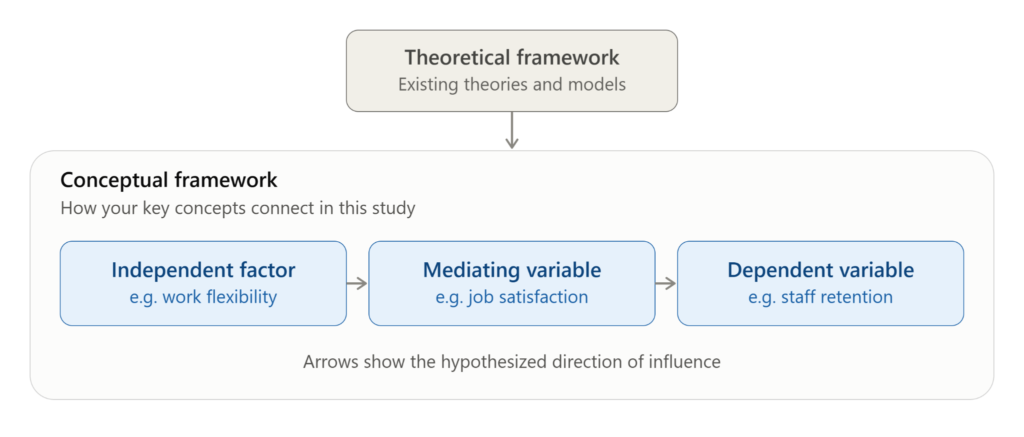
- A conceptual framework is your own synthesis — how you believe the concepts from that theory apply to your specific research problem, context, and variables. It typically appears in your introduction or methodology chapter and feeds directly into your research questions and hypotheses.
In practice, most strong DBA dissertations use both: the theoretical framework supplies the “borrowed” foundation, and the conceptual framework shows how you’ve customized that foundation for your own study.
A simple way to remember the distinction: a theoretical framework asks “what do established scholars say about this phenomenon?” while a conceptual framework asks “how do I expect these specific concepts to interact in my specific study?” One is inherited; the other is built. If your committee keeps sending back comments like “this framework doesn’t reflect your research questions,” it’s usually because these two pieces were developed separately instead of together.
Why a Strong Conceptual Framework Matters for Your DBA Study
Committees don’t ask for a conceptual framework as a formality. It does real work for your dissertation:
- It justifies your research design. Reviewers can see, at a glance, why you chose a quantitative, qualitative, or mixed-methods approach based on how your variables relate.
- It keeps your study focused. Once your framework is set, it becomes much harder to drift into unrelated variables or scope creep during data collection.
- It strengthens your literature review. A clear framework forces you to justify every construct with supporting citations, which tightens your argument.
- It speeds up committee approval. Proposal defenses stall most often when the framework is vague, borrowed without adaptation, or disconnected from the research questions. A precise framework removes that friction.
- It sets up your findings chapter. When you eventually discuss results, you’ll be testing or refining the very relationships your framework proposed — which makes Chapter 4 and 5 far easier to write.
- It gives your study business relevance. Because a DBA is an applied doctorate, your framework also signals to practitioners and future readers exactly how your findings could inform real management decisions, not just academic theory.
In our experience working with DBA candidates across industries, the studies that stall longest at the proposal stage are almost never the ones with weak data collection plans — they’re the ones where the framework doesn’t clearly connect the dots between problem, theory, and method. Fixing the framework early saves months later.
Step-by-Step Process to Build a Conceptual Framework
Here’s a practical sequence DBA candidates can follow, along with a simple research framework example to illustrate each stage.
1. Nail down your research problem and questions first. Your framework should emerge from your research questions, not the other way around. If your question is “How does remote leadership style influence employee engagement in multinational firms?” your framework needs to visualize leadership style, employee engagement, and any moderating variables (like company size or industry).
2. Identify your core constructs and variables. List every concept your study touches — independent variables, dependent variables, mediators, and moderators. In the example above: leadership style (independent), employee engagement (dependent), and organizational culture (potential moderator).
3. Ground each construct in the literature. Every box in your framework diagram needs a citation trail. If you can’t point to at least two or three peer-reviewed sources defining and measuring a construct, it doesn’t belong in your framework yet.
4. Map the relationships. Draw arrows between constructs to show hypothesized direction and, where relevant, strength of influence. This is where your framework starts to look like an actual model rather than a list of terms.
5. Choose a visual format. Boxes and arrows, a systems diagram, or a layered pyramid all work — what matters is that a reader unfamiliar with your study can follow the logic in under a minute.
6. Pressure-test it against your methodology. A conceptual framework built for a quantitative, hypothesis-testing study looks different from one built for a qualitative, exploratory study. Revisit your framework after finalizing your methodology chapter to make sure the two are aligned.
7. Get feedback before you defend it. Share your draft framework with your chair or a research mentor early. Frameworks almost always go through two or three revisions before they’re defense-ready.
A quick research framework example makes this concrete. Suppose your topic is “the effect of flexible work arrangements on retention in the banking sector.” Your framework would show flexible work arrangements as the independent variable, employee retention as the dependent variable, and job satisfaction as a mediating variable in between. An arrow from flexible work arrangements to job satisfaction, and another from job satisfaction to retention, illustrates the mediation path you intend to test. Underneath the diagram, a short paragraph would cite the studies that support each relationship and state the hypothesis each arrow represents. That’s a complete, defense-ready conceptual framework in miniature.
Common Business Research Models You Can Use as a Foundation
You don’t need to invent your framework from scratch. Many DBA studies adapt established business research models as a starting point, then customize them for the specific context:
- The Resource-Based View (RBV): Useful for studies examining how internal resources and capabilities drive competitive advantage — common in strategy-focused DBA topics.
- The Technology Acceptance Model (TAM): A frequent choice for studies on digital transformation, AI adoption, or e-commerce behavior.
- Institutional Theory frameworks: Well suited to research on organizational compliance, governance, or how firms respond to regulatory pressure.
- The Balanced Scorecard model: Often adapted for performance-management or organizational effectiveness studies.
- Stakeholder Theory frameworks: A good fit for ESG, sustainability, or corporate social responsibility research.
Each of these can serve as the theoretical backbone, with your conceptual framework showing exactly how the model’s variables apply to your specific organization, industry, or population.
There’s no single “correct” model — the right choice depends entirely on your research problem and the field you’re contributing to. A useful test is to ask whether the model’s core variables can be operationalized with data you can realistically collect, whether through surveys, interviews, or archival organizational data. A model that looks elegant in a textbook but can’t be measured in your specific context will slow you down rather than help you, so it’s worth discussing your shortlist with your chair before committing to one.
Common Mistakes DBA Candidates Make with Conceptual Frameworks
Even strong researchers stumble here. Watch out for these recurring issues:
- Treating it as decoration. A framework diagram dropped into the dissertation without explanation in the surrounding text won’t satisfy a committee. Every element needs a written justification.
- Borrowing without adapting. Copying a framework from a published study without adjusting it to your context is one of the fastest ways to trigger a “this doesn’t fit your problem” comment from reviewers.
- Too many variables. A framework with ten interacting constructs is usually a sign the research problem itself needs narrowing.
- Framework and methodology mismatch. If your framework implies causal relationships but your study is qualitative and exploratory, that inconsistency will be flagged.
- No connection to research questions. Every construct in your framework should map directly back to a research question or hypothesis — if it doesn’t, cut it.
- Treating the first draft as final. A conceptual framework is meant to evolve as your literature review deepens. Candidates who lock it in too early often find themselves reworking whole sections of Chapter 2 later to match a framework that no longer reflects their reading.
The good news is that every one of these issues is fixable with structured feedback – which is exactly why most successful DBA candidates run their framework past a research mentor or writing coach before submitting it for committee review.
Recommended External Resources
- Grad Coach: Theoretical vs Conceptual Framework — a clear breakdown of how the two frameworks differ, with visual examples.
- Kean University Library Guide: Choosing a Conceptual or Theoretical Framework — an academic library resource walking through how to select and justify a framework for empirical research.
- Administrative Issues Journal: Understanding, Selecting, and Integrating a Theoretical Framework — a peer-reviewed article on building and applying frameworks across qualitative, quantitative, and mixed-methods dissertations.
DBACoach Learning Resources
- DBA Coach Methodology Pillar — our complete guide to research design and methodology decisions for DBA candidates.
- When to Use Qualitative, Quantitative, or Mixed Methods in Research — a practical guide to choosing the right approach for your study.
- Qualitative vs Quantitative DBA: Which Research Method Is Right for You? — helps you decide before you build your framework.
Conclusion
A well-built conceptual framework isn’t just a diagram for your appendix – it’s the logical spine of your entire DBA dissertation. Get it right, and your literature review, methodology, and findings chapters all become easier to write because they’re anchored to the same clear structure. Get it wrong, and you’ll likely spend extra committee rounds untangling relationships that were never clearly defined in the first place.
If you’re building your conceptual model dissertation chapter and want a second set of eyes before your proposal defense, DBA Coach’s research specialists can review your framework, help you select the right business research model, and make sure it’s tightly aligned with your methodology. Book a free session to get feedback on your framework before you submit.