
Struggling to choose your methodology? Learn how to build a strong mixed methods dissertation for your DBA – with designs, examples, and expert coaching support.
Introduction
If you’re a working professional pursuing a Doctor of Business Administration, you already know that the methodology chapter can make or break your dissertation timeline. Among the three broad approaches available to you – qualitative, quantitative, and mixed methods – the mixed methods dissertation has become one of the most popular choices for DBA candidates, and for good reason. Business problems are rarely purely numerical or purely narrative; they involve numbers and human context, metrics and meaning.
This guide walks you through what mixed methods research really means, the core DBA mixed methods design options available to you, a practical mixed methods research example, and how to decide which approach fits your research questions. Whether you’re still finalizing your topic or already drafting Chapter 3, this article will help you make an informed, defensible methodology choice.
What Is a Mixed Methods Dissertation?
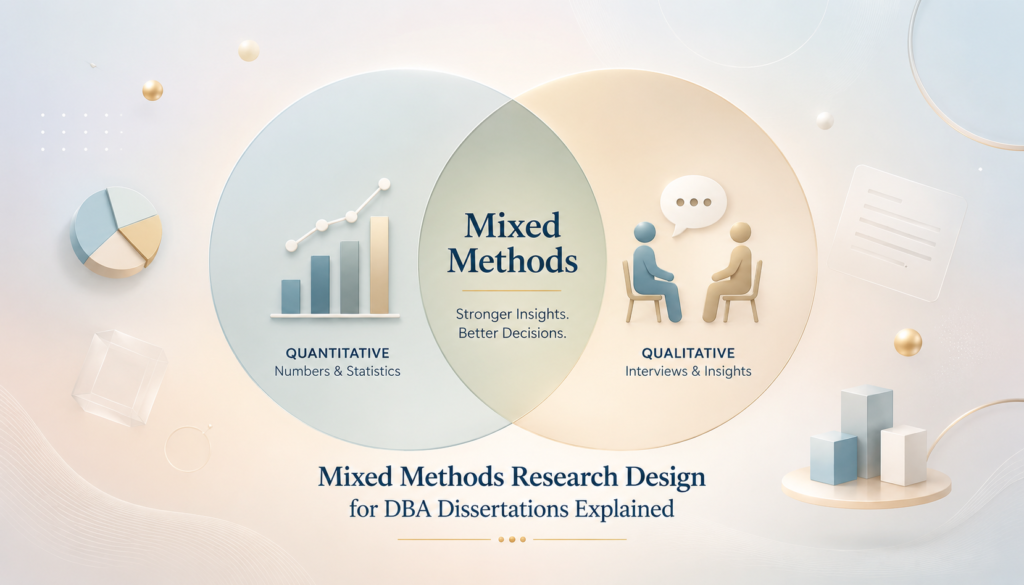
A mixed methods dissertation is a study that intentionally combines quantitative data (numbers, surveys, statistical analysis) with qualitative data (interviews, case studies, open-ended responses) within a single research project. The goal isn’t to run two unrelated studies side by side – it’s to integrate both strands so that one type of data explains, validates, or builds upon the other.
At its core, this approach blends numerical and narrative evidence to answer one unified research question, and it’s particularly well suited to applied business research because it allows you to measure what is happening (through statistics) while also uncovering why it’s happening (through the lived experience of leaders, employees, or customers).
For DBA candidates specifically, this dual lens is valuable because business problems – declining employee engagement, digital transformation resistance, supply chain disruption – are rarely explained by numbers alone. A rigorous doctoral mixed methods study lets you triangulate data sources, strengthen the credibility of your findings, and produce recommendations that are both statistically sound and practically grounded.
Why DBA Candidates Choose Mixed Methods Research
Mixed methods designs are especially popular in DBA programs because they align naturally with practitioner-oriented, applied research. Common reasons candidates choose this path include:
- Richer, more complete findings – quantitative data shows patterns; qualitative data explains them.
- Stronger practical relevance – DBA dissertations are expected to solve real organizational problems, and mixed methods captures both measurable outcomes and stakeholder perspectives.
- Better alignment with a Doctor of Business Administration’s applied focus, compared to the more theory-driven PhD track.
- Triangulation and validity – using two data types to confirm (or challenge) the same conclusion strengthens your defense.
- Flexibility with existing organizational data – many DBA candidates already have access to company metrics (quantitative) and can supplement them with interviews or focus groups (qualitative).
If your research question includes both a “how much/how many” component and a “why/how” component, mixed methods is very likely your best fit.
Core Types of DBA Mixed Methods Design
Not all mixed methods studies look the same. Choosing the right DBA methodology types depends on your research question, timeline, and access to participants or data. The four most commonly used designs in DBA dissertations are:
1. Convergent Parallel Design
Quantitative and qualitative data are collected at roughly the same time, analyzed separately, and then merged during interpretation to see where the results converge or diverge.
- Best for: comparing survey results with interview themes on the same phenomenon.
- Example use: measuring employee engagement scores alongside interview insights on workplace culture.
2. Explanatory Sequential Design
Quantitative data is collected and analyzed first, and qualitative data is collected afterward to help explain unexpected or noteworthy quantitative results.
- Best for: DBA candidates who want statistical findings to guide which participants or themes to explore in more depth.
- Example use: running a regression analysis on sales performance, then interviewing top and bottom performers to explain the variance.
3. Exploratory Sequential Design
Qualitative data is collected first to explore a phenomenon, and the findings inform the development of a quantitative instrument (such as a survey) tested in the second phase.
- Best for: topics where existing measurement tools don’t fully capture the business context, such as an emerging trend like AI adoption in mid-sized firms.
4. Embedded (Nested) Design
One data type plays a supportive role within a study that is primarily quantitative or qualitative – for example, embedding a few open-ended questions within a larger survey.
- Best for: candidates with tighter timelines who still want a secondary layer of insight without running two full-scale phases.
The Convergent, Explanatory Sequential, and Exploratory Sequential designs remain the three most widely used approaches in doctoral-level mixed methods work, and understanding the decision points between them is one of the most important conversations to have with your dissertation chair or methodology coach early on.
A Mixed Methods Research Example for DBA Dissertations
To make this concrete, here’s a simplified mixed methods research example relevant to a typical DBA topic:
Research Problem: A mid-sized manufacturing company wants to understand why its digital transformation initiative has had inconsistent adoption across departments.
Design Chosen: Explanatory Sequential Mixed Methods
- Phase 1 (Quantitative): A structured survey is distributed to 150 employees measuring adoption rates, perceived usefulness, and technology readiness across departments. Statistical analysis identifies which departments show the lowest adoption scores and which variables correlate most strongly with resistance.
- Phase 2 (Qualitative): Based on the survey results, the researcher conducts semi-structured interviews with managers and employees from the lowest-adoption departments to understand the underlying reasons – for example, inadequate training, leadership communication gaps, or workflow disruption concerns.
- Integration: The qualitative themes are used to explain the statistical patterns, producing a set of practical, department-specific recommendations for leadership.
This structure demonstrates exactly what dissertation committees look for: a clear rationale for why mixed methods was necessary, a logical sequence between phases, and a genuine integration of findings rather than two disconnected studies bolted together.
How to Choose the Right DBA Methodology Types for Your Study
Selecting your design isn’t just an academic exercise – it shapes your data collection timeline, IRB approval process, and how convincingly you can defend your findings. Ask yourself:
- Does my research question require both numerical patterns and contextual explanation?
- Do I have (or can I realistically get) access to both quantitative data sources and qualitative participants?
- What is my timeline – can I run sequential phases, or do I need a faster convergent approach?
- Does my organization or industry already have usable quantitative data I can build on?
- Will my dissertation committee or university have a preference for a specific design based on prior cohort approvals?
A well-matched design isn’t the most complex one – it’s the one that most directly answers your research question with the least unnecessary complexity.
Common Challenges in a Doctoral Mixed Methods Study
Mixed methods dissertations are rewarding, but they come with real challenges that DBA candidates should plan for early:
- Time and resource intensity – running two data collection phases takes longer than a single-method study.
- Integration difficulty – many candidates collect both data types but fail to genuinely merge them in the analysis and discussion chapters, which is a common committee critique.
- Conflicting results – quantitative and qualitative findings don’t always agree, and you need a clear strategy for interpreting divergence rather than ignoring it.
- Methodological justification – committees expect a strong rationale for why mixed methods was necessary, not just a summary of the design.
- Sampling and instrument design – building or validating a qualitative interview protocol and a quantitative instrument both require careful planning.
None of these challenges are disqualifying – they’re simply reasons why structured guidance early in your proposal stage saves months of revision later.
Steps to Build Your Mixed Methods Research Design
- Clarify your research questions – write separate quantitative and qualitative sub-questions, then confirm they genuinely require both approaches.
- Select your design type – convergent, explanatory sequential, exploratory sequential, or embedded, based on your timeline and data access.
- Define your population and sampling strategy for both strands.
- Choose or develop your instruments – surveys, interview protocols, or existing organizational datasets.
- Plan your integration strategy – decide in advance how you will merge, connect, or embed the two data types during analysis.
- Address rigor and validity – triangulation, member checking, and instrument reliability all strengthen your defense.
- Draft your methodology chapter with a clear justification tied directly to your research problem and questions.
If you’re weighing methodology decisions like these, our guide on building a strong conceptual framework for your DBA dissertation is a useful companion piece, since your framework should directly inform which design you select.
How DBA Coach Can Help You Design and Defend Your Mixed Methods Dissertation
Choosing and justifying the right methodology is one of the most common places DBA candidates lose momentum – not because the concepts are too difficult, but because there’s no one to sanity-check decisions in real time. At DBA Coach, we work directly with candidates to:
- Match your research problem to the most defensible DBA mixed methods design
- Strengthen your methodology chapter before committee review
- Prepare you to confidently answer methodology questions at your proposal defense
- Support you through sampling strategy, instrument design, and data integration planning
If you’re navigating proposal writing more broadly, our related guides on DBA proposal defense preparation and sampling strategies for doctoral research offer additional support as you build out your full methodology chapter.
Mixed methods research is powerful, but it rewards candidates who plan carefully from the start. If you’d like personalized guidance on whether a mixed methods design is right for your topic – or support building out your full research design – book a free consultation with our team or explore our full range of DBA coaching services.
Frequently Asked Questions
Is mixed methods research harder than a single-method DBA dissertation? It typically requires more planning and a longer data collection timeline, since you’re managing two data strands instead of one. However, many DBA candidates find it more manageable in practice because the qualitative phase often helps make sense of ambiguous quantitative results, reducing the guesswork in your discussion chapter.
Which DBA mixed methods design is most common in business dissertations? Explanatory sequential designs are especially popular for applied business research, since they let you start with measurable organizational data – sales figures, engagement scores, performance metrics – and then use interviews to explain the “why” behind the numbers.
Do I need advanced statistics knowledge for a mixed methods dissertation? Not necessarily advanced statistics, but you do need a solid grasp of basic quantitative analysis (such as descriptive statistics, correlation, or regression, depending on your questions) alongside qualitative coding and thematic analysis skills. Many candidates work with a methodology coach or statistician to strengthen this area rather than learning it entirely alone.
How long does a doctoral mixed methods study typically take to complete? Timelines vary by design and institution, but sequential designs generally take longer than convergent ones because the phases happen one after another rather than simultaneously. Building in extra time for IRB approval, participant recruitment, and data integration is essential regardless of which design you choose.
External Learning Resources:
- Scribbr – What Is Mixed Methods Research? Definition, Guide & Examples
- SAGE Publications – The SAGE Handbook of Mixed Methods Research Design
- NIH Office of Behavioral and Social Sciences Research – Best Practices for Mixed Methods Research in the Health Sciences