
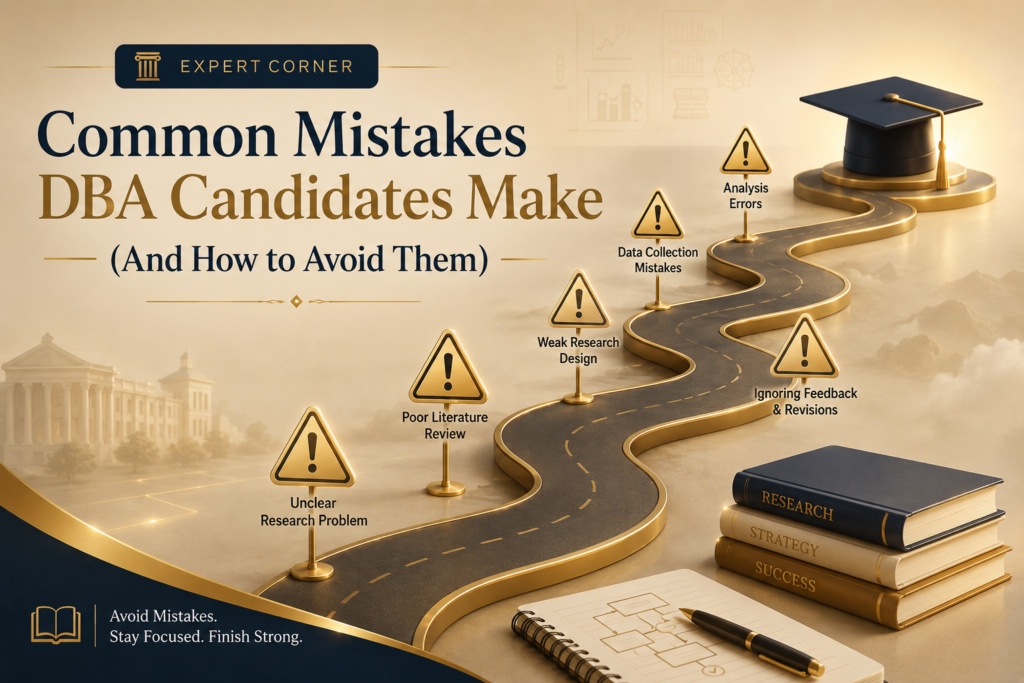
Avoid the pitfalls that stall most DBA candidates. Here are the most common DBA mistakes, why they happen, and how to steer clear of them.
Introduction
Every DBA candidate wants to move through their program efficiently, defend confidently, and graduate on schedule. In practice, most candidates hit the same handful of avoidable obstacles along the way – not because they lack ability, but because nobody warned them these mistakes were coming until it was too late to sidestep them cheaply.
This Expert Corner piece walks through the most common DBA mistakes we see repeatedly across working professionals pursuing their doctorate, why each one happens, and exactly how to avoid it. If you recognize yourself in even one or two of these, you’re in good company – and catching it now can save you months of otherwise avoidable revision.
Why These Mistakes Happen So Often
Most DBA candidate mistakes aren’t the result of poor effort. They happen because a DBA is unlike almost anything else a working professional has done before. Unlike a job with a manager setting daily priorities, a dissertation is almost entirely self-directed – you decide what to work on, how deep to go, and when something is “good enough” to move forward.
That lack of built-in structure, combined with limited time and infrequent feedback, creates the exact conditions where small, avoidable errors compound into major delays. Add to that the isolation many candidates feel without a daily cohort, and the pressure of balancing a full-time career alongside years of independent research, and it becomes clear why the same handful of mistakes show up across so many different programs and industries.
The good news is that nearly every mistake below follows a predictable pattern, which means it can be prevented with the right awareness and a bit of structure – not by working harder, but by working differently in a few specific, targeted ways.
1. Choosing a Topic That’s Too Broad
This is one of the most common DBA dissertation pitfalls, and it’s usually driven by enthusiasm rather than carelessness. New candidates often want their research to matter to an entire industry, when a dissertation actually needs to answer one specific, narrow question well.
- The problem: A topic like “the impact of AI on business” cannot realistically be researched to doctoral depth within a reasonable timeline.
- The fix: Narrow your topic to a specific population, industry, or organizational context – for example, how mid-sized logistics firms in a particular region are adopting a specific technology – before finalizing your proposal.
2. Underestimating How Self-Directed the Process Is
Doctoral work has far less external structure than most professional environments, and candidates who don’t anticipate this often lose momentum in the first year.
- The problem: Without someone assigning weekly tasks, it’s easy to drift, especially during busy work periods.
- The fix: Build your own structure early – a weekly time block, a running task list, and a monthly check-in with your chair or a coach – rather than waiting for the program to provide it.
3. Poor Time Management Around a Full-Time Job
Nearly every working DBA candidate underestimates how much time dissertation work actually requires once real analysis and writing begin.
- The problem: Treating dissertation work as something to “fit in when there’s time” usually means it never happens consistently.
- The fix: Protect specific, recurring blocks of time each week, even if they’re short, and set a minimum weekly progress target you can hit even during demanding work periods.
4. Ignoring or Mishandling Committee Feedback
Feedback from your chair or committee is one of the most valuable resources available to you, yet many candidates either avoid it or fail to act on it systematically.
- The problem: Vague feedback like “strengthen your literature review” often gets left unaddressed because it isn’t broken down into a clear next step.
- The fix: After every meeting, convert feedback into a short list of specific, actionable tasks, and track what’s completed versus outstanding before your next conversation.
5. Weak Justification for the Chosen Methodology
Committees frequently send proposals back not because the methodology itself was wrong, but because the candidate never clearly explained why it was the right fit for the research question.
- The problem: Simply stating “this study will use a qualitative approach” without a clear rationale invites committee pushback.
- The fix: Explicitly connect your methodology choice to your specific research question, your access to data, and your practical constraints, and be ready to defend that reasoning directly.
If you’re still working through this decision yourself, our guide on choosing the right research methodology for your DBA dissertation walks through how to match your question to a defensible design.
6. Formatting, Citation, and Preliminary Page Errors
These issues are minor individually, but they add up, and they are often the first thing a committee notices before they even reach your findings.
- The problem: Inconsistent citations, incomplete preliminary pages, or a formatting style that doesn’t match your program’s template can create an unprofessional first impression.
- The fix: Use your program’s official dissertation template from day one, and run a dedicated formatting and citation check before every major submission rather than leaving it for the final pass.
7. Letting Perfectionism Replace Real Progress
Perfectionism disguises itself as diligence, but it is one of the most common doctoral research common errors we see slow candidates down.
- The problem: Rewriting an already-acceptable paragraph, or endlessly searching for “one more source,” feels productive but doesn’t actually move the dissertation forward.
- The fix: Separate your work into distinct stages – draft, improve, finalize – and resist polishing a section before the surrounding chapter even exists in draft form.
8. Working in Isolation Without Accountability
A DBA can be a genuinely isolating experience, especially for candidates without a built-in cohort or regular peer contact.
- The problem: Without any external accountability, it’s easy for weeks or months to slip by without meaningful progress, and without anyone noticing until a deadline is missed.
- The fix: Build in a recurring accountability structure, whether that’s a peer group, a regular check-in with your chair, or a dissertation coach tracking your progress with you.
9. Misunderstanding What the Defense Actually Involves
Many candidates walk into their proposal or final defense with an inaccurate picture of what’s expected, which creates unnecessary anxiety and weak preparation.
- The problem: Treating the defense as a simple pass-or-fail test, rather than a genuine discussion of your research, often leads candidates to over-rehearse a presentation while under-preparing for follow-up questions.
- The fix: Prepare to explain and defend your choices in conversation, not just present slides – practice answering “why” questions about your methodology, findings, and limitations out loud.
How to Avoid DBA Mistakes Before They Cost You Time
Looking across all nine of these patterns, a few practices consistently separate candidates who move steadily through their program from those who stall:
- Narrow your topic and methodology early, with a clear, specific rationale for both
- Build a realistic, recurring schedule instead of relying on motivation alone
- Convert every piece of feedback into a specific, trackable action
- Get a second set of eyes on formatting, citations, and structure before major submissions
- Set up accountability – a peer, chair, or coach – rather than working in isolation
None of these fixes require dramatically more time. They require catching the pattern early enough that a small adjustment prevents a much larger delay later. If you’re navigating this alongside a demanding career, our guide on balancing a full-time job with your DBA dissertation offers a practical weekly system that pairs well with the fixes above.
How DBA Coach Helps You Avoid These Pitfalls
Most of the mistakes covered here are hard to catch on your own, simply because you’re too close to your own work to see the pattern clearly. That’s exactly where an experienced second set of eyes makes the biggest difference. At DBA Coach, we work directly with candidates to catch these issues early – sharpening an overly broad topic, strengthening a weak methodology justification, or building the accountability structure that keeps momentum going through a demanding career.
If you’d like a personalized review of where your own dissertation might be at risk, you can explore our full range of DBA coaching services or book a free consultation with our team.
Conclusion
Nearly every candidate who struggles through their DBA is dealing with one or two of the same avoidable patterns covered here – not a lack of ability, but a lack of early awareness. Choosing a focused topic, building real structure around your time, acting on feedback systematically, and setting up genuine accountability will resolve most of the friction points that cause candidates to stall. The earlier you catch these patterns, the less they cost you in lost time and unnecessary revision.
If you’d like an experienced second opinion on where your own dissertation might be exposed to these common pitfalls, book a free consultation with our team, and let’s map out a clearer path forward together.
External Learning Resources:
- Grand Canyon University – 6 Common Dissertation Mistakes and How to Avoid Them
- Walden University – Six Common Dissertation Mistakes to Avoid
- Times Higher Education – Five Common Mistakes to Avoid When Writing Your Doctoral Dissertation