
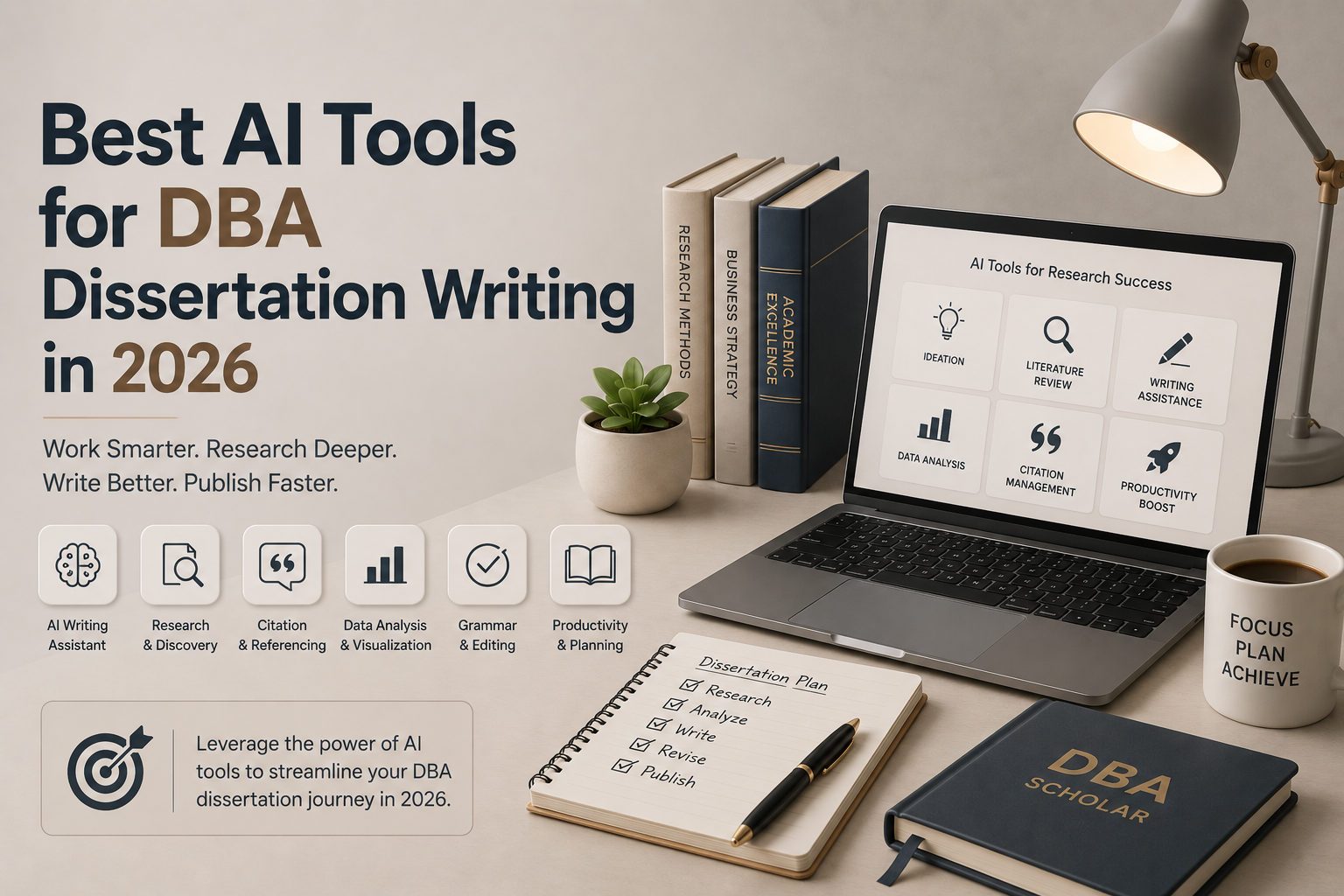
Best AI Tools for DBA Dissertation Writing in 2026
Discover the best AI tools for DBA dissertation writing to improve research, writing, citations, and productivity ethically
Introduction
Artificial Intelligence has transformed the way doctoral students conduct research, organize literature, analyze data, and write dissertations. In 2026, AI is no longer just a productivity tool – it has become an essential research assistant for many DBA scholars. From refining research questions and summarizing journal articles to generating citation formats and improving academic writing, the right AI tools can save countless hours while enhancing the quality of your work.
However, AI should be used responsibly. Universities increasingly expect doctoral candidates to maintain academic integrity by using AI ethically, verifying AI-generated outputs, and ensuring originality in their research. AI should assist your thinking – not replace it.
In this guide, we explore the best AI tools for DBA dissertation writing in 2026, highlighting their features, ideal use cases, advantages, and limitations. Whether you are working on your literature review, research methodology, data analysis, or final editing, these tools can help streamline your dissertation journey while maintaining scholarly standards.
1. ChatGPT: Your AI Research and Writing Assistant
One of the most versatile AI tools for DBA dissertation writing is ChatGPT. It helps doctoral students brainstorm ideas, improve academic writing, simplify complex concepts, and organize dissertation chapters.
Useful In:
- Refining research questions
- Explaining theoretical frameworks
- Improving academic language
- Creating dissertation outlines
- Drafting summaries
Benefits:
- Saves time during writing
- Enhances clarity and coherence
- Supports brainstorming
- Assists with proofreading
Limitations:
- AI-generated references must always be verified.
- Outputs should be reviewed for originality and accuracy.
Best Practice: Use ChatGPT as an assistant rather than an author.
2. Elicit: Accelerating Literature Reviews
Conducting a comprehensive literature review is often the most time-consuming stage of a DBA dissertation. Elicit simplifies this process by searching academic papers, summarizing findings, and identifying relevant studies.
Useful In:
- Literature review
- Research gap identification
- Paper summarization
- Evidence synthesis
Key Features:
- AI-powered paper summaries
- Research question refinement
- Literature comparison tables
- Citation extraction
For DBA scholars, Elicit significantly reduces the time required to review hundreds of research articles while maintaining a systematic approach.
3. Consensus: Finding Evidence-Based Answers
Consensus is an AI-powered academic search engine that retrieves findings directly from peer-reviewed research.
Instead of searching the web, it searches scientific literature.
Ideal For:
- Evidence-based research
- Hypothesis validation
- Identifying scholarly consensus
- Quick literature searches
Consensus helps scholars avoid unreliable online information by focusing on academic publications.
4. Grammarly & Paperpal: Academic Writing Enhancement
Strong academic writing is essential for dissertation success.
Grammarly
Grammarly improves:
- Grammar
- Sentence structure
- Readability
- Academic tone
Paperpal
Paperpal is specifically designed for researchers.
It helps with:
- Academic editing
- Journal-ready writing
- Technical language improvement
- Reviewer-style suggestions
These tools improve writing quality without changing the author’s intellectual contribution.
5. Zotero & Scite: Citation and Reference Management
Managing hundreds of references manually can be overwhelming.
Zotero
Zotero helps scholars:
- Store journal articles
- Organize references
- Generate citations
- Create bibliographies
Scite
Scite goes beyond citation management.
It tells researchers:
- Which papers support a claim
- Which papers contradict findings
- Which studies merely mention a publication
This makes Scite particularly valuable when developing arguments in your literature review.
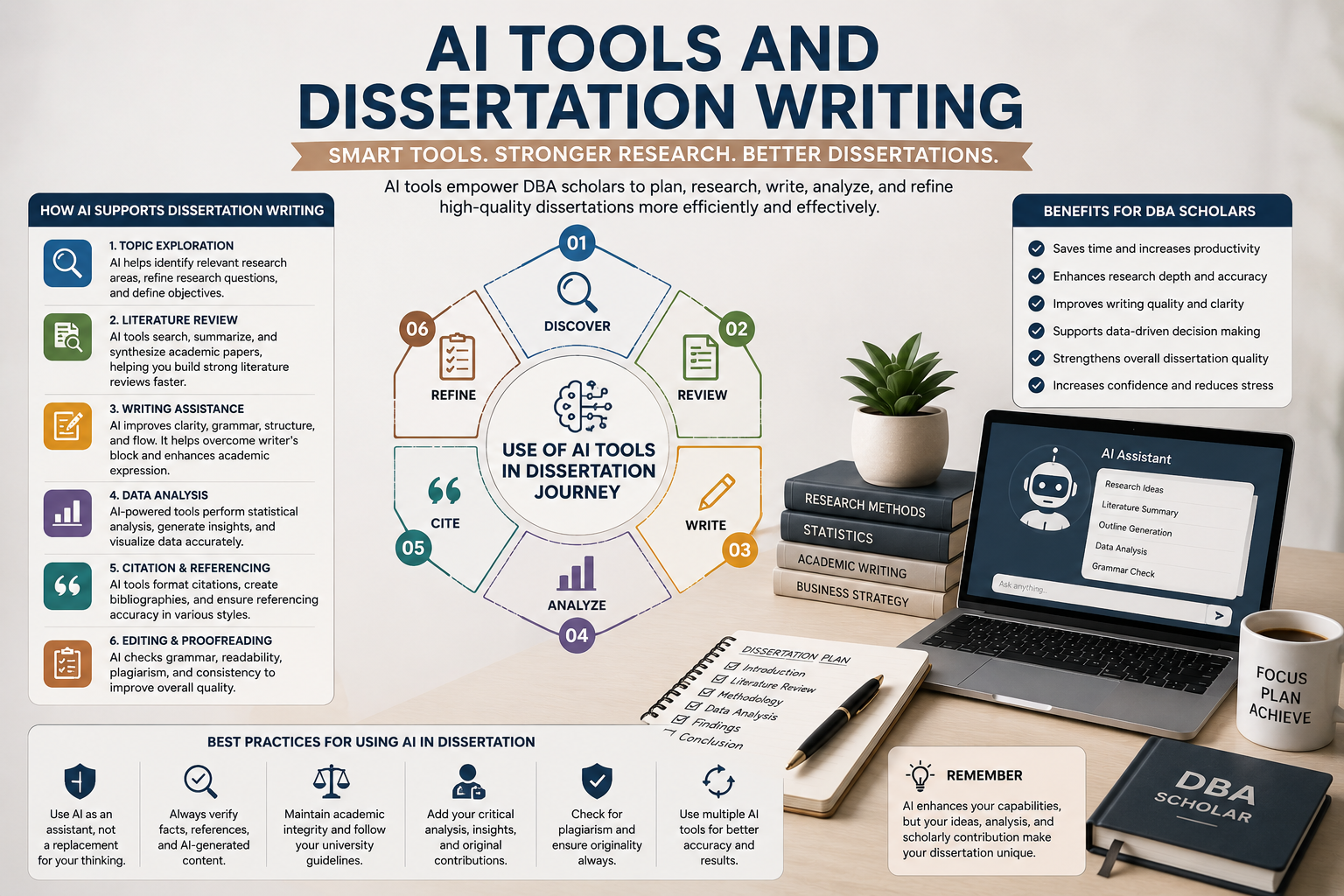
How to Use AI Ethically in Your DBA Dissertation
While AI improves productivity, responsible use is essential.
Follow these best practices:
✔ Verify every citation
✔ Read original journal articles
✔ Never submit AI-generated work without review
✔ Follow your university’s AI policy
✔ Use AI to support – not replace – critical thinking
Ethical AI use strengthens your research while protecting academic integrity.
External Learning Resources
Explore these trusted AI tools to support your DBA dissertation writing:
Internal Learning Resources
- https://dbacoach.com/how-to-demonstrate-a-research-gap-in-your-literature-review-chapter
- https://dbacoach.com/how-to-publish-your-dba-research-in-scopus-journals/
- https://dbacoach.com/how-to-conduct-a-systematic-literature-review-for-dba
Conclusion
The emergence of AI tools for DBA dissertation writing has transformed how doctoral scholars approach research, writing, and dissertation management. Tools like ChatGPT, Elicit, Consensus, Grammarly, Paperpal, Zotero, and Scite can significantly improve productivity, streamline literature reviews, enhance academic writing, and simplify citation management.
However, these tools should complement – not replace – your scholarly expertise. Original thinking, critical analysis, ethical research practices, and academic integrity remain the foundation of a successful DBA dissertation. By combining AI-powered efficiency with rigorous research methodology, you can produce high-quality doctoral work that meets university standards and contributes meaningfully to business knowledge.
If you’re looking for personalized guidance, DBA Coach offers expert support for every stage of the dissertation process – from topic selection and literature review to methodology, data analysis, and final submission. Download our Free AI Dissertation Toolkit for DBA Scholars and take the next step toward completing your dissertation with confidence.