
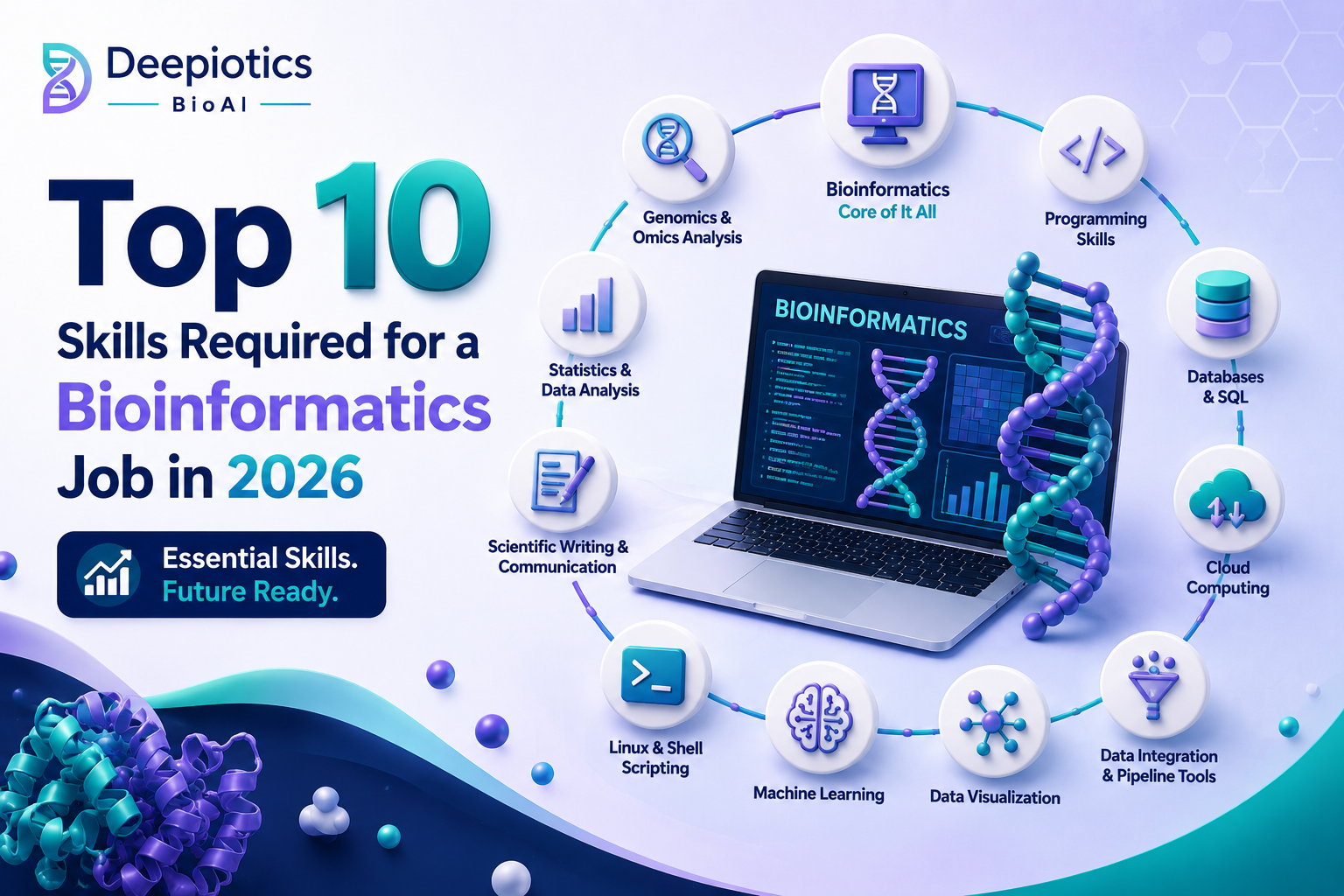
1. Understanding NGS Workflows
Modern genomics laboratories rely heavily on Next-Generation Sequencing (NGS).
Every aspiring bioinformatician should understand the complete sequencing workflow, including:
- FASTQ files
- Read quality assessment
- Sequence alignment
- Variant calling
- Biological interpretation
You don’t need to memorize every command-line option.
Instead, understand how each step connects to the overall biological question.
Why Recruiters Value This Skill
Candidates who understand complete NGS pipelines require less training and can contribute to research projects more quickly.
2. Data Analysis & Biological Interpretation
Running software is easy.
Understanding what the results actually mean is what differentiates professionals from beginners.
Strong bioinformaticians can:
- Interpret sequencing results
- Identify biological patterns
- Explain experimental outcomes
- Connect computational results to biological hypotheses
- Draw meaningful scientific conclusions
Why Recruiters Value This Skill
Organizations need professionals who convert complex datasets into actionable biological insights.
3. Familiarity with Bioinformatics Tools
Bioinformatics combines biology with specialized computational software.
Commonly used platforms include:
- Galaxy
- BLAST
- IGV
- FastQC
- MultiQC
The goal isn’t memorizing every feature.
Instead, know:
- When to use each tool
- What problem it solves
- How different tools fit into an analysis pipeline
Why Recruiters Value This Skill
Candidates who already understand widely used bioinformatics platforms become productive much faster.
4. Basic Programming Knowledge
One of the biggest myths about bioinformatics is that you need to become an expert software developer.
That’s not true.
However, understanding basic programming concepts dramatically improves your efficiency.
Learn concepts like:
- Variables
- Loops
- Conditional statements
- File handling
- Simple scripting
Languages commonly used include:
- Python
- R
- Bash
Why Recruiters Value This Skill
Programming enables automation, reproducibility, and problem-solving.
5. Statistics for Biological Data
Statistics is often underestimated but forms the foundation of modern biological research.
You’ll encounter statistics in:
- Differential gene expression
- RNA-Seq analysis
- Experimental design
- Hypothesis testing
- Data validation
You don’t need advanced mathematics.
A strong understanding of statistical fundamentals is enough to get started.
Why Recruiters Value This Skill
Reliable scientific decisions depend on sound statistical analysis.
6. Biological Database Knowledge
Every bioinformatician works with biological databases.
Important resources include:
- NCBI
- Ensembl
- UniProt
You should know:
- What information each database contains
- How to retrieve sequences efficiently
- How to search annotations
- How to extract relevant biological information
Why Recruiters Value This Skill
Efficient database usage saves valuable research time.
7. Data Visualization Skills
Complex datasets become meaningful only when communicated clearly.
Useful visualization techniques include:
- Heatmaps
- Volcano plots
- PCA plots
- Pathway diagrams
- Expression charts
- Interactive dashboards
Why Recruiters Value This Skill
Clear visualization helps researchers, clinicians, and decision-makers understand results quickly.
8. Scientific Communication
Technical expertise alone isn’t enough.
Successful professionals know how to communicate science effectively.
Develop skills in:
- Scientific writing
- Report preparation
- Presentation design
- Explaining results to non-computational researchers
- Cross-functional collaboration
Why Recruiters Value This Skill
Bioinformaticians frequently work alongside molecular biologists, clinicians, statisticians, and pharmaceutical scientists.
Strong communication improves collaboration.
9. Practical Projects & Portfolio Development
Employers hire based on demonstrated skills—not certificates alone.
Build a portfolio containing projects such as:
- NGS analysis
- RNA-Seq workflows
- Variant analysis
- Genome annotation
- Differential expression studies
- Galaxy workflows
- Biological case studies
Include:
- Methods used
- Results obtained
- Biological interpretation
- GitHub repository (if applicable)
Why Recruiters Value This Skill
Projects demonstrate that you can solve real-world biological problems.
10. Continuous Learning & Adaptability
Bioinformatics evolves rapidly.
New sequencing technologies, AI models, databases, and computational methods emerge every year.
Successful professionals:
- Stay updated with new tools
- Read scientific literature
- Learn emerging technologies
- Continuously improve their analytical skills
Why Recruiters Value This Skill
Adaptability ensures long-term career growth in a rapidly changing industry.
Ready to Become Job-Ready?
At Deepiotics BioAI, we believe practical experience is the foundation of a successful bioinformatics career.
BioAI Lab is designed to help life science students and early-career researchers gain hands-on experience with industry-relevant bioinformatics workflows.
Whether you’re preparing for internships, higher studies, or your first bioinformatics role, our structured learning approach helps you build confidence through real-world projects.
📥 Download the Free Bioinformatics Skills Roadmap
Start your bioinformatics journey with our free career roadmap.
You’ll Get:
✅ Step-by-step learning sequence
✅ Top skills employers prioritize
✅ Practical project ideas
✅ Portfolio-building guidance
✅ Career preparation tips
🚀 Start Learning Today
Visit: https://bioai.deepiotics.com
Build practical bioinformatics skills. Gain real-world experience. Become industry ready.