
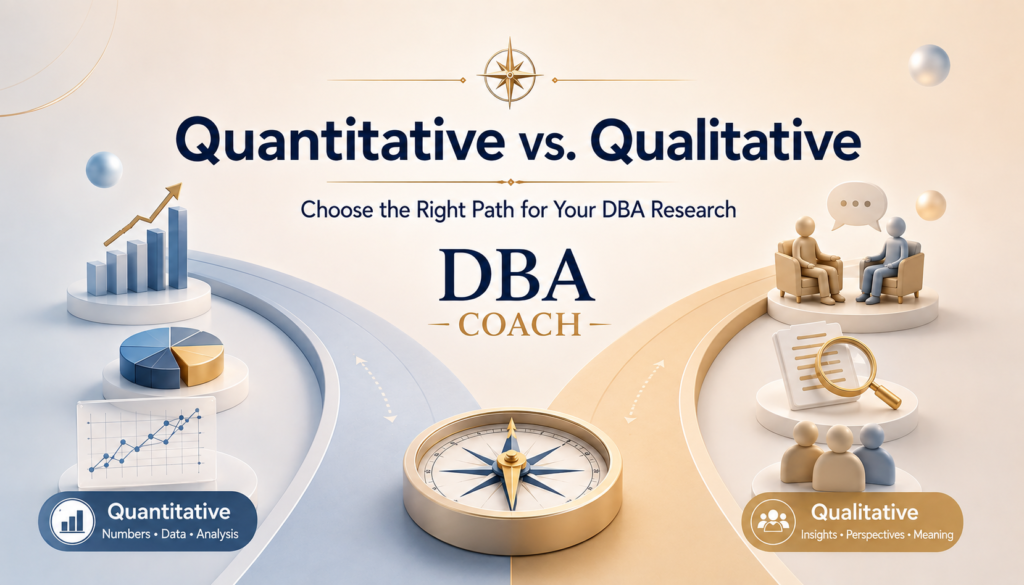
Confused about your research methodology for DBA Dissertation? This guide walks you through choosing between quantitative, qualitative, and mixed methods with confidence.
Introduction
For most Doctor of Business Administration candidates, there is one decision that quietly shapes the entire dissertation journey: choosing the right methodology. Long before the data collection begins, before the committee meetings, and before the defense, this single choice determines how you will investigate your research problem, what kind of evidence you will gather, and how convincingly you will be able to defend your conclusions. Yet for many working professionals balancing a demanding career with doctoral study, selecting a DBA research methodology can feel more confusing than it should be. Should you run a statistical study, conduct interviews, or combine both? Which approach fits your research questions, your access to data, and your available time?
This guide is designed to walk you through that decision with clarity. We will look at the major categories of doctoral business research methods, compare quantitative vs qualitative DBA approaches, and offer a practical framework for choosing research methodology DBA candidates can apply to their own topic. By the end, you should have a much clearer sense of which direction fits your research problem, and where to turn if you want expert guidance along the way.
Why Methodology Choice Matters So Much in a DBA Dissertation
A DBA dissertation is different from a typical PhD in one important way: it is meant to be applied. Your research is expected to solve a real, practical business problem, not simply add to academic theory for its own sake. This applied focus has a direct effect on methodology, because the method you choose needs to produce evidence that is both academically rigorous and useful to practitioners, organizations, or industries.
Choosing the wrong methodology, or choosing one without a clear rationale, is one of the most common reasons DBA proposals get sent back for revision. A methodology chapter that simply states “this study will use a qualitative approach” without justifying why that approach is the only one capable of answering the research question will almost always draw committee pushback.
On the other hand, a well-reasoned methodology chapter builds instant credibility, because it shows your committee that you have thought carefully about the relationship between your research question, your data, and your conclusions.
This is why methodology selection deserves far more attention than it typically gets in the early stages of a DBA program. Getting this right early saves months of revision later, and it is often the single biggest factor separating candidates who move steadily through their program from those who stall at the proposal stage.
Understanding the Three Broad Approaches
Before comparing specific methods, it helps to understand the three broad categories that nearly every DBA dissertation methodology guide will point you toward: quantitative, qualitative, and mixed methods.
Quantitative research relies on numerical data and statistical analysis to test relationships, measure outcomes, or examine patterns across a population. It is well suited to research questions that ask “how much,” “how many,” or “whether X affects Y.” A DBA candidate studying the relationship between remote work policies and employee productivity, for example, might use a quantitative survey and statistical analysis to test that relationship across a large sample.
Qualitative research, by contrast, is built around exploring meaning, experience, and context. It relies on interviews, focus groups, case studies, or document analysis to understand how and why something happens, rather than simply measuring that it happens. A DBA candidate investigating how senior leaders make decisions during a merger, for instance, might rely on qualitative interviews to capture the nuance and reasoning behind those decisions in a way that numbers alone could never reveal.
Mixed methods research combines both approaches within a single study, using quantitative data to measure patterns and qualitative data to explain them. This approach has become increasingly common in DBA programs because it mirrors the reality of business problems, which are rarely explained by numbers or narratives alone.
Quantitative vs Qualitative DBA Research: How to Decide
The quantitative vs qualitative DBA decision usually comes down to the nature of your research question rather than personal preference. If your research question is asking about measurable relationships, comparisons, or trends across a large group, a quantitative approach is likely the better fit. This includes questions like measuring the impact of a new pricing strategy on customer retention, testing whether leadership style correlates with employee turnover, or comparing financial performance across different business models.
If, on the other hand, your research question is asking about perceptions, experiences, or the reasoning behind a phenomenon, qualitative research will usually serve you better. This includes questions like understanding how employees experience organizational change, exploring how small business owners make strategic decisions under uncertainty, or examining the cultural factors behind resistance to digital transformation.
There are also practical considerations that should influence your decision beyond the nature of the question itself. Quantitative research typically requires access to a large enough sample to produce statistically meaningful results, along with comfort working with statistical software and analysis techniques. Qualitative research requires strong interviewing and coding skills, along with the time needed to transcribe, code, and analyze rich narrative data. Many candidates find that being honest about their own comfort level with data analysis, alongside a clear read of what their research question actually requires, leads to a far more confident methodology decision.
Doctoral Business Research Methods Within Each Approach
Once you have chosen a broad category, you still need to select a specific method within it, and this is where many candidates need additional guidance. Within quantitative research, common doctoral business research methods include descriptive surveys, correlational studies, experimental or quasi-experimental designs, and secondary data analysis using existing organizational or industry datasets. Each of these serves a different purpose. A correlational design, for example, is appropriate if you want to examine the relationship between two or more variables without manipulating them directly, while an experimental design is appropriate if you are testing a specific intervention or change under controlled conditions.
Within qualitative research, common methods include case studies, phenomenological research, grounded theory, ethnography, and narrative inquiry. A case study approach works well when you want an in-depth understanding of a single organization, department, or business event. Phenomenological research is a strong fit when you want to understand the lived experience of a specific group, such as first-time female executives or employees navigating a major layoff. Grounded theory is particularly useful when there is little existing theory to explain a phenomenon and you want your research to generate new theoretical insight directly from the data.
If your research question calls for elements of both, you will also need to choose among the specific mixed methods designs, such as convergent, explanatory sequential, or exploratory sequential approaches, each of which structures the relationship between your quantitative and qualitative phases differently. We cover these designs, along with a full walkthrough of how to structure a mixed methods study, in our detailed guide on mixed methods research design for DBA dissertations, which is a useful next read if you suspect a combined approach may fit your topic.
A Practical Framework for Choosing Your Methodology
With so many options available, it helps to work through a structured set of questions rather than trying to decide everything at once. Start with your research question itself, and ask honestly whether it is asking you to measure something, explain something, or both. From there, consider your access to data and participants. Some DBA candidates already have rich access to organizational data through their own workplace, which can make a quantitative or mixed methods design far more feasible than starting from scratch with an unfamiliar population.
Next, think realistically about your timeline. Quantitative studies using existing data can sometimes move faster than qualitative studies that require scheduling and conducting a series of interviews, while sequential mixed methods designs typically take the longest of all because they involve two distinct data collection phases. Consider your own skill set as well, since a methodology that plays to your strengths in either statistical analysis or qualitative interviewing will be easier to execute well and defend confidently.
Finally, look at what has been approved in your program before you finalize your decision. Reviewing recently completed dissertations from your university, and if possible from your specific dissertation chair, will give you a realistic sense of which methodologies are well supported by your committee and which may require additional justification. This step alone can save significant time during the proposal review process.
Common Mistakes DBA Candidates Make When Choosing a Methodology
Even experienced professionals often stumble at this stage, and a handful of mistakes show up again and again in DBA proposals. One of the most common is choosing a methodology because it seems easier, rather than because it truly fits the research question. Committees can usually tell when a method has been chosen for convenience rather than genuine alignment with the research problem, and this mismatch tends to surface as a major revision request.
Another frequent mistake is underestimating the practical demands of a chosen method, such as assuming interview recruitment will be straightforward or that a large enough survey sample will be easy to reach. A third common issue is failing to clearly justify the methodology in writing, even when the underlying reasoning is sound. Committees expect to see an explicit explanation of why your chosen approach is the most appropriate way to answer your specific research question, not simply a description of what the method involves.
Being aware of these pitfalls early gives you the chance to address them before they slow down your proposal process, and it is one of the areas where working with an experienced methodology coach can make the biggest difference.
How DBA Coach Can Help You Choose and Defend Your Methodology
Selecting the right methodology is rarely a decision you should make entirely on your own, and having an experienced sounding board can save you months of back-and-forth with your committee. At DBA Coach, we work directly with candidates to evaluate their research questions, match them to the most defensible methodology, and strengthen the justification in their methodology chapter before it ever reaches committee review.
If you are also refining your sampling approach as part of this process, our guide on sampling strategies for DBA dissertations is a helpful companion resource, since your sampling plan needs to align closely with whichever methodology you choose. And if you would like a clear, personalized action plan for your own dissertation methodology, you can explore our full range of DBA coaching services or book a free consultation directly with our team.
Conclusion
Choosing the right research methodology is one of the most consequential decisions you will make in your DBA journey, and it deserves careful, honest reflection rather than a rushed choice made under deadline pressure. By starting with your research question, weighing your access to data and participants, being realistic about your timeline and skill set, and grounding your decision in what has worked in your program before, you can approach this stage with far more confidence than most candidates do. A methodology decision made this thoughtfully will not only move more smoothly through committee review, it will also set the foundation for a stronger, more defensible dissertation from proposal through final defense.
If you would like personalized guidance on choosing between quantitative, qualitative, or mixed methods for your own topic, book a free consultation with our team, and let’s map out a clear methodology plan together.
External Learning Sources:
- Scribbr — How to Create a Research Design
- Statistics Solutions — Choosing the Research Design and Methodology for Your Dissertation
- ACE Blog — Qualitative vs. Quantitative: Comparing Research Methods for Ed.D. Dissertations