
Discover how DBA candidates can use AI for literature review – the right tools, smart workflows, and how to stay academically rigorous.
Introduction
For most DBA candidates, the literature review is one of the longest and most demanding stages of the dissertation journey. It requires sifting through hundreds of academic articles, identifying the studies that genuinely matter, mapping out theoretical gaps, and synthesizing everything into a coherent narrative that justifies your research problem. It is no surprise that this stage is also where many working professionals feel their momentum stall the most, simply because there are not enough hours in the week to read everything a rigorous literature review demands.
Artificial intelligence has changed this equation significantly. Using AI for literature review no longer means cutting corners – when used correctly, it means working faster through the mechanical parts of research so you can spend more of your limited time on the parts that actually require doctoral-level judgment: interpretation, synthesis, and argument-building. This guide walks through how DBA candidates can responsibly bring AI into their literature review process, which tools are worth exploring, and where the line sits between smart use of technology and academic risk.
Why Literature Reviews Are So Time-Consuming for DBA Candidates
Before looking at how AI fits in, it helps to understand why this stage is so demanding in the first place. A strong literature review is not simply a summary of what has already been written on a topic. It requires identifying patterns across dozens or hundreds of sources, recognizing where scholars disagree, spotting gaps that your own research can address, and organizing all of it into themes rather than a source-by-source list. For DBA candidates specifically, this work is almost always squeezed into evenings and weekends around a full-time job, which makes the sheer volume of reading required feel especially overwhelming.
Traditional literature review methods rely on manually searching academic databases, scanning abstracts, downloading PDFs, and keeping track of everything in spreadsheets or reference managers. This process works, but it is slow, and it is easy to lose track of which sources actually support which argument once your reading list grows into the hundreds. This is precisely the gap that AI-powered research tools have been built to close.
How AI Is Changing the Literature Review Process
Modern AI research assistant tools can now interpret a research question in natural language and retrieve conceptually relevant papers, rather than requiring you to guess the exact keywords a database might index. Instead of manually reading every abstract to judge relevance, many tools can screen large batches of papers and flag the ones most likely to matter to your specific research question, dramatically cutting down the initial filtering stage.
Beyond search and screening, a newer generation of tools can also extract structured findings directly from dense academic PDFs, pulling out details such as methodology, sample size, key findings, and limitations into a comparable table format. This is particularly useful for DBA candidates conducting systematic review AI-supported research, where consistency in how each source is evaluated matters as much as the findings themselves. Some platforms go a step further, offering citation mapping that visually shows how papers relate to and build on one another, which can help you quickly spot influential studies and emerging clusters of research within your field.
It is worth noting that this shift is not a minor convenience. Industry researchers on academic AI tooling have observed that AI-assisted review processes can meaningfully reduce the manual workload involved in screening, extracting, and organizing sources compared to fully manual methods, while still preserving methodological rigor when paired with careful researcher oversight. For a DBA candidate balancing a demanding career with doctoral study, that kind of time recovery can be the difference between steady progress and a stalled proposal.
Categories of AI Literature Review Tools DBA Candidates Should Know
Not all AI research tools serve the same purpose, and understanding the different categories will help you build a more efficient workflow rather than relying on a single tool to do everything.
- Discovery tools are designed to help you find relevant papers in the first place, often using semantic search that understands the meaning behind your research question rather than matching exact keywords. These tools are especially useful in the early stages of your literature review, when you are still mapping the boundaries of your topic and identifying which subfields are most relevant.
- Screening and extraction tools focus on narrowing down a large pool of papers into the ones worth reading closely, and then pulling structured data out of those papers once you have selected them. These tools are particularly valuable for doctoral literature review help when your topic requires evaluating a large volume of empirical studies with consistent criteria, since manually tracking dozens of variables across hundreds of papers by hand is both slow and error-prone.
- Citation mapping tools visualize the relationships between papers, showing which studies cite each other and which ones sit at the center of a research conversation. This can help you quickly identify seminal works in your field and trace how a theoretical concept has evolved over time, which is often difficult to piece together through keyword searching alone.
- Finally, synthesis and writing support tools help you organize themes, draft summaries, and structure your review chapter once your reading is largely complete. These tools should be used carefully, since this is the stage where academic voice, critical analysis, and original argumentation matter most, and where over-reliance on AI-generated text creates the greatest risk to your academic integrity.
Where AI Genuinely Helps DBA Candidates
Used thoughtfully, AI can meaningfully accelerate several parts of the literature review process without compromising the doctoral rigor your committee expects. It is especially useful for the initial discovery phase, helping you identify a broad, relevant pool of sources far faster than manual database searching alone. It is also valuable for organizing and comparing large numbers of empirical studies, since tools that extract methodology, sample, and findings data into structured tables can save hours of manual note-taking.
AI can also help you spot patterns and gaps across your source pool that might otherwise take much longer to notice, such as a cluster of studies that all share a methodological limitation, or a subtopic that has been under-researched relative to the rest of your field. Used this way, AI functions less like a shortcut and more like a research assistant handling the repetitive groundwork, freeing you to focus on the interpretive work that actually demonstrates doctoral-level thinking.
Where DBA Candidates Should Be Cautious
The line between smart AI use and academic risk usually shows up at the writing stage rather than the search stage. Using AI to help you find, filter, and organize sources is generally low-risk and widely accepted, but using AI to generate substantial portions of your actual literature review narrative is a different matter entirely. Committees are trained to recognize writing that lacks a genuine critical voice, and AI-generated summaries often read as descriptive rather than analytical, which is exactly the weakness DBA committees are quick to flag.
There is also a real risk of relying on AI-generated citations or summaries without verifying them against the original source. Even well-regarded AI research tools can occasionally misattribute a finding or oversimplify a nuanced argument, and it remains entirely your responsibility as the researcher to confirm that every citation in your literature review accurately reflects the source it points to. Before adopting any AI tool into your workflow, it is also worth checking your university’s specific policy on AI use in doctoral research, since expectations vary considerably between institutions and even between departments.
The safest approach is to treat AI as a research accelerant rather than a research author: let it help you search, screen, and organize, but keep the actual synthesis, argumentation, and academic voice entirely your own. If you are still refining your broader approach to this chapter, our guide on choosing the right research methodology for your DBA dissertation is a useful companion resource, since your literature review should directly inform and support the methodology you ultimately select.
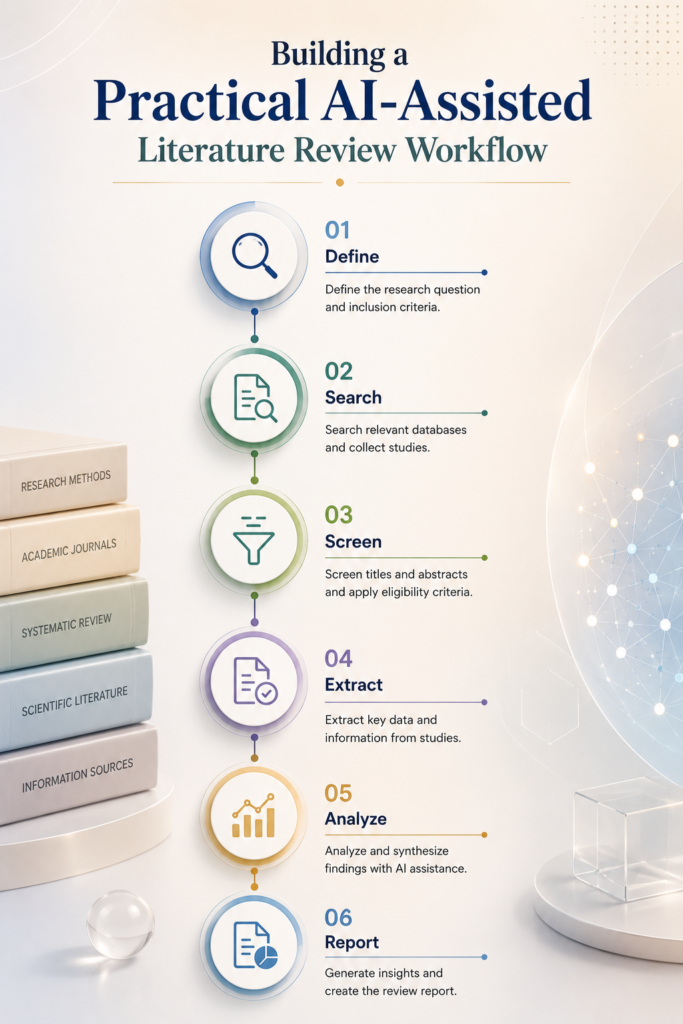
Building a Practical AI-Assisted Literature Review Workflow
A sensible starting workflow begins with using a discovery tool to build an initial pool of papers based on your research question, casting a reasonably wide net before narrowing down. From there, a screening tool can help you filter that pool down to the studies most relevant to your specific research problem, based on criteria you define rather than criteria the tool assumes on your behalf.
Once you have a focused set of sources, an extraction tool can help you pull structured details from each paper into a comparison table, which becomes an invaluable reference as you begin identifying themes and gaps. From there, the actual writing – organizing those themes into a coherent narrative, building your argument for why your research problem matters, and identifying the specific gap your study will address – should remain firmly in your own hands, informed by the groundwork AI helped you complete more efficiently.
This kind of layered workflow reflects how experienced researchers are increasingly approaching their reviews in 2026: using different tools for different stages rather than expecting a single platform to manage the entire process from search through final draft.
How DBA Coach Can Help You Navigate AI in Your Literature Review
Deciding how much AI assistance is appropriate for your specific program, topic, and committee can be genuinely difficult to judge on your own, and getting it wrong can cost you significant time in revisions. At DBA Coach, we help candidates build a literature review strategy that uses the right tools for the right stages while keeping the analytical core of the chapter authentically yours.
If you are earlier in your research process and still working through your broader design decisions, our guide on mixed methods research design for DBA dissertations may also be useful, since your literature review and methodology chapter should reinforce one another. And if you would like hands-on support structuring your literature review chapter, you can explore our full range of DBA coaching services or book a free consultation with our team.
Conclusion
AI has genuinely changed what is possible in a DBA literature review, making the discovery, screening, and organization stages faster and more manageable than they have ever been. Used well, it gives working professionals back valuable time without sacrificing the rigor your committee expects. The key is knowing where to draw the line – leaning on AI to handle the mechanical, repetitive work while keeping the critical thinking, synthesis, and academic voice entirely your own. Candidates who strike that balance tend to move through this stage with far more confidence, and with a literature review that genuinely reflects doctoral-level thinking rather than just efficient searching.
If you would like guidance on building a literature review workflow that fits your topic and your program’s expectations, book a free consultation with our team, and let’s map out a plan together.
External Learning Resources:
- Paperguide – 7 Best Literature Review AI Tools in 2026
- Researcher.Life – Top 5 AI Tools for Literature Review in 2026
- Bohrium – Best AI Tools for Literature Review in 2026: Features, Use Cases, and Workflow