
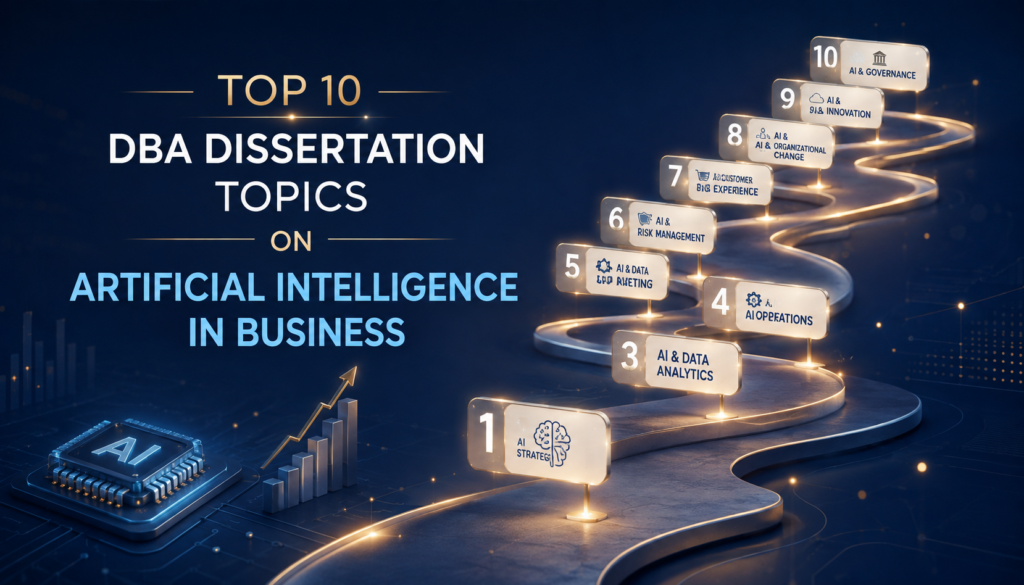
Struggling to pick a topic? Explore 10 timely DBA dissertation topics on AI in business, backed by current 2026 research trends and practical guidance.
Introduction
DBA Dissertation Topics on AI in Business.
Choosing a dissertation topic is one of the most important decisions a DBA candidate will make, and right now, few areas offer as much relevance, urgency, and research opportunity as artificial intelligence in business. Organizations across every industry are actively restructuring strategy, operations, and leadership around AI, which means there is no shortage of real, unresolved business problems for a doctoral researcher to investigate. The challenge for most candidates is not whether to explore AI, but which angle to pursue in a way that is specific enough to be researchable, current enough to be relevant, and aligned enough with their own professional background to sustain years of sustained work.
This article walks through ten strong DBA dissertation topics AI-focused candidates can consider heading into 2026, each grounded in genuine shifts happening across industries right now. Whether you are drawn to strategy, leadership, operations, or governance, there is likely a version of these topics that fits your own career context and research interests. We will also cover how to narrow a broad AI topic into something genuinely defensible, and where to turn if you want expert guidance shaping your final proposal.
Why AI Is Such a Rich Area for DBA Research Right Now
The applied nature of a DBA dissertation means your research is expected to solve a real organizational problem, not simply contribute to abstract theory. AI fits this requirement unusually well, because most organizations are still working through genuine, unresolved questions about how to adopt it responsibly and profitably. Executive research suggests companies are increasingly shifting from experimentation toward operational, enterprise-wide AI strategies, which means there is a growing gap between how quickly leadership wants to move and how well-understood the organizational, human, and governance implications actually are.
This gap is exactly where strong doctoral research AI topics tend to live. A DBA dissertation does not need to predict the future of AI technology itself; it needs to examine how organizations, leaders, and employees are responding to the changes already underway. That distinction matters, because it keeps your research grounded in business practice rather than technical speculation, which is precisely what DBA committees expect to see.
Top 10 DBA Dissertation Topics on AI in Business
1. Agentic AI Adoption and Organizational Readiness
As organizations move beyond simple generative AI tools toward autonomous, goal-driven AI agents capable of planning and acting independently, many are discovering that their internal processes, governance structures, and workforce skills are not yet ready for this shift. A dissertation in this space could examine what organizational factors predict successful agentic AI adoption, or how mid-sized firms specifically differ from large enterprises in their readiness.
2. AI Governance Frameworks and Risk Management in Mid-Sized Enterprises
Much of the current research and guidance on AI governance is written for large, resource-rich enterprises, leaving a meaningful gap in understanding how mid-sized and smaller organizations are building (or struggling to build) responsible AI oversight. This topic works well for candidates in risk, compliance, or operations roles.
3. The Changing Role of Middle Management in AI-Driven Organizations
As AI systems increasingly handle reporting, forecasting, and routine analysis, several organizations are beginning to see real changes in what middle managers actually do day to day. A DBA dissertation could investigate how middle management roles are evolving, what new skills are becoming essential, or how this shift affects employee engagement and retention.
4. AI-Driven Personalization and Its Impact on Customer Loyalty
Personalization powered by AI has moved from a competitive advantage to a baseline expectation in many industries, and organizations that lead in this area report meaningfully stronger revenue outcomes than those that do not. This topic is well suited to candidates with a marketing, retail, or customer experience background who want to study personalization’s effect on loyalty, retention, or lifetime value within a specific industry.
5. Organizational Resilience Amid Continuous AI Disruption
Business researchers have begun describing the ability to continuously adapt to AI-driven change as a distinct organizational capability, sometimes referred to as “change fitness.” A dissertation could explore what specific leadership practices or organizational structures build this capability, and how it correlates with successful AI adoption outcomes.
6. AI Strategy Sequencing: Predictive vs. Generative AI Prioritization
Emerging research suggests that organizations benefit from deliberately sequencing their AI investments, prioritizing predictive AI in some contexts and generative AI in others depending on their strategic goals. This offers a strong angle for an AI strategy dissertation ideas candidate interested in strategic decision-making, since it allows for a comparative or case-study design across firms or industries.
7. Trust, Transparency, and Explainability in AI-Driven Decision-Making
As AI systems take on a larger role in decisions that affect employees, customers, and stakeholders, questions about transparency and explainability have moved from a technical concern to a core leadership and governance issue. A dissertation here could examine how organizations build stakeholder trust in AI-driven decisions, or how transparency practices affect employee acceptance of AI tools.
8. The Executive Time Investment Gap in AI Capability Building
Recent research has found a meaningful link between how much time senior leaders personally invest in building their own AI fluency and how much value their organizations ultimately generate from AI initiatives. This is a compelling, underexplored topic for candidates interested in leadership development, executive behavior, or organizational learning.
9. AI Adoption and Competitive Differentiation in Small and Medium Enterprises
While much of the current AI business research focuses on large, well-resourced organizations, small and medium enterprises face a very different set of constraints, resources, and risks. A DBA dissertation examining how SMEs in a specific sector are using AI to compete against larger, better-funded rivals fills a genuine and often-cited gap in the literature.
10. Data Readiness as a Predictor of AI Return on Investment
Despite heavy investment in AI, many organizations report that their underlying data is not yet consistent, governed, or accessible enough to fully support AI at scale, and this gap appears to be a significant driver of disappointing ROI. A dissertation in this space could examine the relationship between organizational data maturity and measurable AI outcomes within a specific industry or function.
How to Narrow a Broad AI Topic Into a Defensible Dissertation
Each of the topics above is intentionally broad, because a strong DBA dissertation topic needs room to be shaped around your specific access to data, your industry background, and your committee’s expectations. The next step after selecting a general direction is narrowing it into a specific, researchable problem statement.
Start by identifying a specific population or context, such as a particular industry, company size category, region, or functional area, rather than trying to study AI adoption broadly across all organizations. From there, clarify exactly what outcome you are trying to explain or measure, whether that is adoption success, employee response, financial performance, or organizational change. Finally, consider what data you can realistically access, since many of these topics work particularly well if you already have some level of access to organizational data or subject matter experts through your own career.
If you are further along and already thinking about how to structure your research design around one of these topics, our guide on choosing the right research methodology for your DBA dissertation walks through how to match your research question to the most defensible quantitative, qualitative, or mixed methods approach.
Using AI Responsibly as You Research Your AI Topic
There is a certain irony in researching AI adoption while also being tempted to use AI tools throughout your own dissertation process, and it is worth approaching this thoughtfully from the start. AI research assistant tools can genuinely help you manage the literature review stage of an AI-focused dissertation, especially given how quickly new studies and industry reports are being published in this space. If you plan to use AI tools to support your own literature review, our guide on using AI for literature review covers where these tools genuinely help and where DBA candidates should remain cautious to protect academic rigor.
How DBA Coach Can Help You Choose and Refine Your AI Dissertation Topic
Selecting from a list of broad topic ideas is only the first step; narrowing your chosen direction into a specific, defensible research problem is where most candidates benefit from experienced guidance. At DBA Coach, we work directly with candidates to evaluate potential DBA topics 2026 against their access to data, professional background, and program requirements, helping shape a topic that is both genuinely interesting to research and realistic to complete on schedule.
If you already have a general direction in mind and want support turning it into a full proposal, you can explore our complete range of DBA coaching services, or book a free consultation to talk through your options directly with our team.
Conclusion
Artificial intelligence is reshaping business practice quickly enough that genuine research gaps are opening up faster than the academic literature can keep pace, which makes this an unusually strong moment to build a DBA dissertation around it. Whether your interest lies in strategy, leadership, governance, or operations, there is very likely a version of these ten topics that connects directly to your own professional experience and the organizations you already understand well. The key is choosing a direction broad enough to matter and specific enough to complete, then building your methodology and literature review around that focused problem from day one.
If you would like personalized guidance narrowing down your own AI dissertation topic, book a free consultation with our team, and let’s map out a clear, defensible research direction together.
Frequently Asked Questions
Do I need a technical background in AI to research this topic for my DBA? No. DBA research on AI focuses on business, organizational, and leadership questions – how companies adopt AI, how it changes roles and decisions, and what drives successful outcomes. You need enough familiarity with AI concepts to discuss them credibly, but you are not expected to build or evaluate the underlying technology itself.
How do I know if an AI topic is too broad for a dissertation? A useful test is whether you can state your research problem in a single, specific sentence naming a particular population, context, and outcome. If your topic still sounds like a magazine headline – “AI and the future of business” – it likely needs to be narrowed to a specific industry, function, or organizational outcome before it is ready for a proposal.
Will an AI-focused topic still be relevant by the time I finish my dissertation? Yes, as long as your research question focuses on organizational and leadership dynamics rather than a specific tool or technology version. Questions about governance, adoption readiness, workforce impact, and strategic decision-making tend to remain relevant even as the specific AI tools in use continue to evolve.
External Learning Resources:
- Deloitte Insights – Tech Trends 2026
- MIT Sloan Management Review – Five Trends in AI and Data Science for 2026
- BCG – AI Radar 2026: As AI Investments Surge, CEOs Take the Lead