
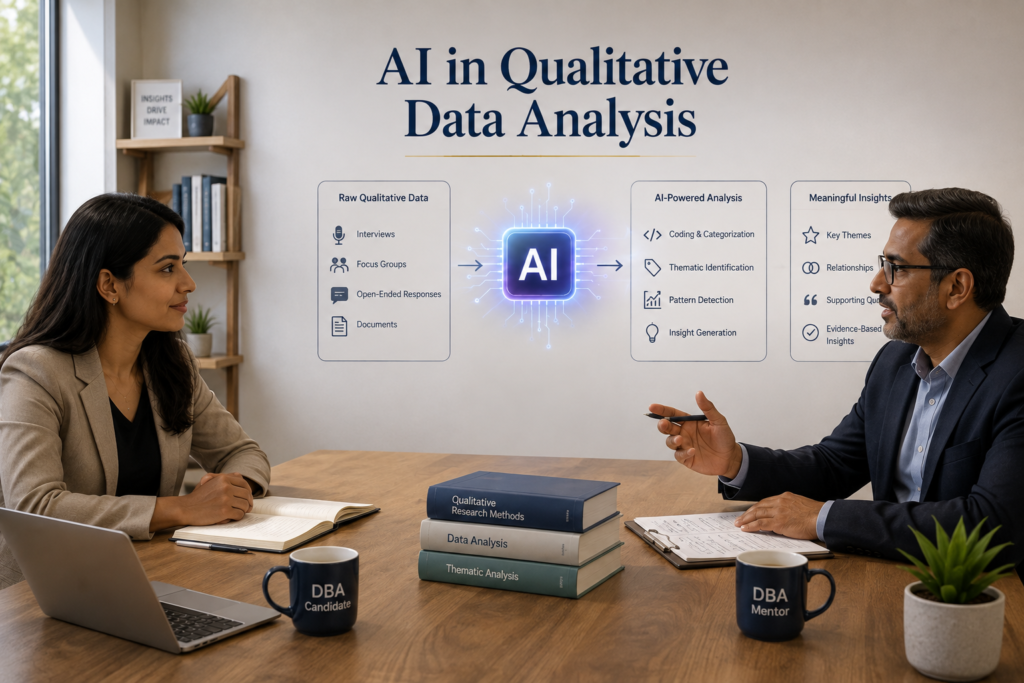
AI in Qualitative Data Analysis – Curious how AI fits into qualitative coding and thematic analysis? Here’s what DBA researchers need to know before bringing AI into their dissertation.
Introduction
Qualitative data analysis has always been one of the most time-intensive parts of a DBA dissertation. Transcribing interviews, coding hundreds of pages of text, and working through multiple rounds of theme development can easily consume months of a working professional’s already limited research time. In the last couple of years, AI in qualitative data analysis tools have started changing that equation, offering researchers real support with summarization, early-stage coding, and pattern recognition across large qualitative datasets.
For DBA candidates, this raises an important and practical question: how much of this work can AI genuinely help with, and where does relying on it start to put your academic rigor at risk? This guide walks through what today’s AI-assisted qualitative tools actually do, how to use them responsibly within a doctoral research process, and where the line sits between smart efficiency and a committee-flagged shortcut.
Why Qualitative Analysis Is So Demanding for DBA Candidates
Qualitative research in a DBA dissertation typically involves interviews, focus groups, or case study documents that need to be transcribed, coded, and organized into themes that support your research argument. Unlike quantitative analysis, where software can calculate a result in seconds, qualitative analysis depends on human judgment at nearly every step – deciding what a passage means, whether it fits an existing code, and how individual codes build into a broader theme.
This is exactly why qualitative analysis is often the stage where working professionals feel their momentum slow down the most. A single hour-long interview can take several hours to transcribe and code properly, and a study built around 15 to 20 participant interviews can easily represent hundreds of hours of manual analysis work. Against that backdrop, it’s easy to see why AI-assisted tools have become so appealing to doctoral researchers balancing this workload with a full-time career.
How AI Is Being Used in Qualitative Data Analysis Today
Modern qualitative data analysis software has moved well beyond simple text search and manual tagging. Established platforms like NVivo and MAXQDA have built AI features directly into their existing coding environments, rather than replacing the researcher-led process altogether. In practice, this generally shows up in a few specific ways:
- Summarization – generating a first-pass summary of a lengthy transcript or document so you can quickly orient yourself before deep coding
- AI-suggested coding – proposing possible codes for a passage based on patterns in your existing codebook, which the researcher then reviews and confirms
- Memoing support – helping draft initial memo text that a researcher can refine and expand with their own analytical reflection
- Pattern and sentiment detection – flagging recurring language, sentiment shifts, or clusters across large datasets that might be worth a closer look
Crucially, current qualitative software is generally designed around a “human-in-the-loop” model, where AI suggestions are reviewed and confirmed by the researcher rather than applied automatically. This is a meaningful distinction for doctoral research specifically, since the final coding and interpretive decisions still need to reflect your own analytical judgment for your dissertation to hold up under committee scrutiny.
NVivo AI Features DBA Candidates Should Know
Because NVivo remains one of the most widely used qualitative platforms in doctoral programs, it’s worth understanding specifically how its NVivo AI features fit into a typical DBA workflow. Recent versions have introduced an AI Assistant capability that supports several tasks researchers previously did entirely by hand:
- Summarizing long documents or transcripts to speed up initial familiarization
- Suggesting possible child codes based on the structure of an existing codebook
- Drafting early memo text that a researcher can revise and build on
- Supporting Framework Matrix summaries for structured qualitative comparisons
These features are designed to accelerate the early, mechanical stages of analysis, not to replace the interpretive work that follows. NVivo’s own product positioning is explicit about this distinction, framing its AI tools as support for researcher judgment rather than a substitute for it. For a DBA candidate working through a dense interview dataset, this kind of support can meaningfully cut down the hours spent on first-pass reading and initial code suggestions, freeing up more time for the deeper comparative and interpretive work each chapter actually requires.
AI Coding in Qualitative Research: What It Can and Can’t Do
Understanding the real boundaries of AI coding qualitative research tools is essential before building them into your dissertation workflow. These tools are generally strong at:
- Speeding up first-pass familiarization with large volumes of text
- Suggesting candidate codes based on patterns already present in your codebook
- Helping you spot recurring language or themes across a large dataset that might otherwise take much longer to notice manually
They are considerably weaker at:
- Understanding the specific theoretical framework guiding your study
- Recognizing subtle contextual meaning, irony, or contradiction within a participant’s response
- Making the final judgment call about whether a passage genuinely supports a theme, which remains an inherently interpretive decision
This is why most established qualitative platforms treat AI-suggested codes as a starting point for the researcher to confirm or reject, rather than a finished analytical output. Treating an AI suggestion as your final coding decision – without your own review and justification – is one of the fastest ways to introduce inconsistency into your findings and raise red flags during your defense.
Thematic Analysis AI Tools: Where They Fit in the Six-Phase Process
Thematic analysis typically follows a well-established six-phase process: familiarization, coding, generating initial themes, reviewing themes, refining and naming themes, and writing up the analysis. Thematic analysis AI tools tend to be most useful in the earlier phases of this process and progressively less useful as you move toward the interpretive end:
- Familiarization – AI-generated summaries can help you quickly orient yourself across a large set of transcripts before deep reading begins
- Coding – AI-suggested codes can speed up your first coding pass, provided you review and adjust every suggestion against your own judgment
- Generating and reviewing themes – AI tools can help surface potential patterns worth exploring, but grouping codes into meaningful themes still requires your own analytical reasoning
- Refining, naming, and writing up – this stage should remain almost entirely researcher-led, since it is where your specific theoretical contribution and academic voice come through most clearly
Used this way, AI functions as an accelerant for the mechanical front-end of thematic analysis, while leaving the analytical backbone of the chapter in your hands, exactly where your committee expects it to be.
Doctoral Data Analysis AI: Staying Academically Rigorous
For doctoral data analysis AI use to hold up under committee scrutiny, a few practices matter more than which specific tool you choose. Before adopting any AI-assisted qualitative tool, check your university’s specific policy on AI use in doctoral research, since expectations vary meaningfully between institutions and even between individual dissertation chairs. It’s also worth documenting how and where you used AI assistance within your methodology chapter, since transparency about your process tends to strengthen rather than weaken your credibility with a committee.
Beyond documentation, always independently verify AI-suggested codes or summaries against the original transcript rather than accepting them at face value, and be prepared to explain your coding decisions in your own words during your defense, since a committee member may reasonably ask why a particular passage was coded the way it was. The safest general approach is to treat AI as a research assistant handling the repetitive groundwork, while keeping the actual interpretation, theme development, and academic argument entirely your own.
If you are earlier in your research process and want to understand how your literature review connects to this stage, our guide on using AI for literature review covers a similar set of considerations for the research stage that typically comes before data analysis.
Building a Responsible AI-Assisted Qualitative Workflow
A sensible starting workflow begins by using AI-generated summaries to orient yourself across your full dataset before diving into detailed coding. From there, allow AI-suggested codes to inform your first coding pass, but review every suggestion individually rather than accepting them in bulk. As themes begin to emerge, take over the grouping and refinement process yourself, using AI only to help you spot patterns you might otherwise miss rather than to define your themes outright.
This kind of layered approach reflects how many doctoral researchers are increasingly working in 2026 – treating AI as one tool among several in a broader qualitative workflow, rather than expecting a single platform to manage the process from raw transcript to finished chapter. If you are still deciding whether a qualitative, quantitative, or mixed approach fits your research question in the first place, our guide on choosing the right research methodology for your DBA dissertation can help you work through that earlier decision.
How DBA Coach Can Help You Navigate AI in Your Data Analysis
Deciding exactly how much AI assistance is appropriate for your specific program, topic, and committee is genuinely difficult to judge alone, and getting it wrong can mean significant revision time later in your process. At DBA Coach, we help candidates build a qualitative analysis workflow that uses AI tools responsibly while keeping the interpretive core of the chapter authentically theirs.
If you would like hands-on support structuring your data analysis chapter or preparing to defend your coding decisions, you can explore our full range of DBA coaching services or book a free consultation with our team.
Conclusion
AI has genuinely changed what’s possible in qualitative data analysis, cutting down the hours spent on transcription review, first-pass coding, and initial pattern-spotting in a way that can meaningfully help working professionals move through this stage of their dissertation. Used well, it gives you back valuable time without compromising the rigor your committee expects. The key, as with most AI-assisted research work, is knowing exactly where to draw the line – letting AI handle the mechanical groundwork while keeping the coding decisions, theme development, and analytical voice entirely your own.
If you would like guidance building a qualitative data analysis workflow that fits your topic and your program’s expectations, book a free consultation with our team, and let’s map out a plan together.
External Learning Resources: