
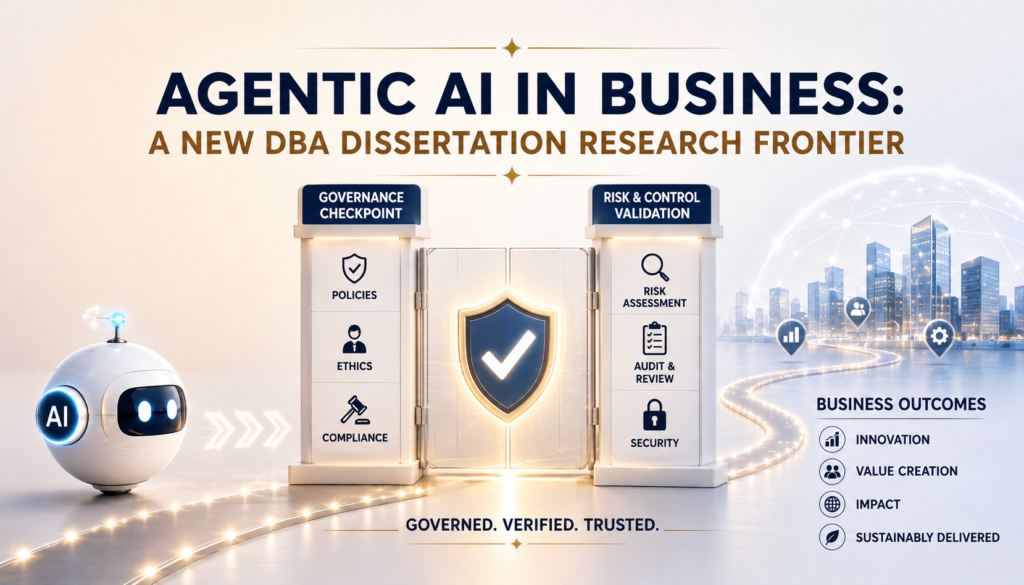
Agentic AI is reshaping enterprises faster than research can keep up. Discover why it’s one of the strongest, least-explored DBA dissertation topics right now.
Introduction
Every few years, a shift in business technology arrives that outpaces the academic literature trying to explain it. Right now, that shift is agentic AI in business – a move away from AI systems that simply respond to prompts, toward autonomous AI agents that plan, decide, and execute multi-step tasks with minimal human direction. Enterprises are adopting this technology at a pace few researchers anticipated, and the organizational, governance, and leadership questions it raises are still largely unanswered in the academic literature.
For DBA candidates searching for a topic that is genuinely current, practically relevant, and still wide open for original contribution, agentic AI represents one of the strongest opportunities available in 2026. This article explains what agentic AI actually is, why it has opened up such a significant research gap, and how DBA candidates can shape a specific, defensible dissertation topic around it.
What Is Agentic AI, and Why Does It Matter for Business Research?
Agentic AI refers to AI systems that can independently work toward a defined objective, planning and carrying out a sequence of actions on their own rather than waiting for a person to trigger each step. Where earlier generative AI tools needed a human to initiate every request, agentic systems can plan a sequence of actions, execute them, and adjust based on results, often coordinating with other AI agents or business systems along the way.
This distinction matters enormously for business research. Analysts tracking enterprise technology have projected that roughly four in ten enterprise applications could carry built-in, task-specific AI agents before 2026 is over, a sharp rise from the barely-there adoption levels of just a couple of years earlier.
That pace of adoption means organizations are making structural decisions about autonomy, oversight, and accountability faster than most academic frameworks have been built to evaluate them.
Why Agentic AI Is a Genuine Research Gap Right Now
Most existing business literature on AI still focuses heavily on generative tools – chatbots, content generation, and decision-support systems that keep a human in the loop for every action. Agentic AI introduces a fundamentally different set of questions, because these systems can now hold something close to organizational identity: access to internal systems, defined privileges, and the ability to interact directly with other agents and platforms across a company’s operations and supply chain.
Industry researchers have also observed a wide gap between experimentation and full production use – most enterprises say they’ve adopted AI agents in some form, but only a small minority have moved them into live, ongoing operations. That gap reflects how hard it still is to weave autonomous systems into everyday processes and accountability structures.
For a DBA dissertation, this tension is a natural fit, since it sits squarely between strategy, technology, and organizational behavior rather than purely technical territory.
Where the Academic Literature Hasn’t Caught Up
Several specific areas within agentic AI remain notably underexplored in peer-reviewed business research, which creates genuine openings for doctoral research agentic AI candidates to contribute original insight rather than simply summarizing existing work.
Governance and control is one of the clearest gaps. As agents take on real operational authority, businesses are designing systems where an agent operates independently but hands off high-risk decisions to a person. How organizations set and adjust these thresholds remains largely undocumented in academic research.
Workforce and role transformation is another. As agents take over multi-step tasks once coordinated by teams, the effect on job design, middle management, and employee trust is still poorly understood empirically – most existing insight comes from vendor case studies, not academic analysis.
Security and accountability is a third gap. Agents now interact directly with systems and partners across a company’s full supply chain, creating exposure older security models weren’t built for – yet little rigorous research examines how organizations are adapting their risk frameworks in response..
Large enterprises currently lead in formal adoption, thanks to bigger teams and budgets – but mid-market and smaller companies are catching up faster via accessible, pre-built tools. Adoption patterns by company size remain a real, underexplored research gap.
Turning Agentic AI Into a Defensible DBA Dissertation Topic
A broad interest in “agentic AI and business” is not yet a dissertation topic – it is a research area. Turning it into something defensible requires narrowing it around a specific population, outcome, and research question, much like any other strong entry on a list of DBA dissertation topics AI candidates might consider.
One direction: what organizational factors predict successful agentic AI adoption in high-stakes industries like healthcare or finance. Another: how mid-sized firms approach AI governance differently than large enterprises with dedicated compliance teams. A third: how middle managers and frontline employees adapt and build trust as agents take over previously human-coordinated tasks.
Each of these directions benefits from being grounded in a specific, accessible population, whether that means your own industry, organization, or professional network, since agentic AI adoption data is still relatively difficult to access through public sources alone.
What Committees Will Expect From an Agentic AI Dissertation
Choosing a genuinely current topic like agentic AI means far less risk of your research question feeling stale by defense time. But it comes with an expectation: your dissertation needs to frame its contribution around organizational and leadership dynamics, not the specifics of any single AI platform or vendor.
In practice, focus your question on decision-making authority, governance structure, workforce adaptation, or risk management – dynamics that stay relevant even as the tools change. “How do mid-sized financial firms structure oversight for autonomous AI agents” holds up far better over a multi-year timeline than “how effective is a specific vendor’s platform,” which risks going stale before your defense.
Committees will also expect you to engage seriously with the limited existing literature while being transparent about the gap you’re addressing. Since peer-reviewed research on agentic AI is still thin, you’ll likely lean more on industry reports and analyst research – just be clear about the line between peer-reviewed sources and industry commentary. That also means your methodology chapter needs to work harder to establish rigor, since you can’t lean on a large body of prior empirical studies.
Common Research Gaps DBA Candidates Can Realistically Address
Given how recent this shift is, DBA candidates are unusually well positioned to contribute genuinely original research rather than simply building on a large existing body of work, which can actually make the literature review stage more manageable. At the same time, this means your methodology needs to be especially rigorous, since you may be working with a smaller pool of prior academic studies and a heavier reliance on industry reports, case studies, and primary data collection.
This is also an area where being deliberate about your methodology pays off. A dissertation examining organizational readiness or governance maturity often benefits from a mixed methods approach, combining survey data on adoption patterns with interviews that explain the reasoning behind governance decisions. If you are still working through which broad methodology fits your research question, our guide on choosing the right research methodology for your DBA dissertation walks through how to match your question to a defensible quantitative, qualitative, or mixed methods design.
How DBA Coach Can Help You Shape an Agentic AI Dissertation Topic
Because this is such a fast-moving area, narrowing a broad interest in agentic AI into a specific, researchable dissertation topic benefits enormously from experienced guidance. At DBA Coach, we help candidates evaluate emerging topics like this one against their access to data, professional background, and program requirements, so the final topic is both genuinely original and realistic to complete on schedule.
If you are still exploring your options more broadly, our guide on 10 DBA dissertation topics on AI in business covers additional angles beyond agentic AI specifically. And if you are ready for hands-on support shaping your proposal, you can explore our full range of DBA coaching services or book a free consultation with our team.
Conclusion
Agentic AI is moving into the core of enterprise operations faster than academic research can keep pace – and that gap is exactly what makes it such a compelling area for DBA research right now. Whether your interest lies in governance, workforce transformation, security, or adoption by company size, there’s genuine room to contribute original insight rather than revisit well-covered ground. Candidates who move on this now stand to produce research that’s both timely and genuinely valuable.
If you would like personalized guidance shaping an agentic AI dissertation topic around your own background and access to data, book a free consultation with our team, and let’s map out a clear research direction together.
External Learning Resources:
- Spectro Cloud – Enterprise AI Trends in 2026: Sovereign, Agentic, Edge, AI Factories
- CloudKeeper – Top Agentic AI Trends to Watch in 2026
- Svitla Systems – Agentic AI Market Trends 2025-2026: 5 Shifts That Matter